Trench spec
How deep should a French drain be?
On most Central Texas residential yards the pipe sits somewhere between eighteen inches and three feet. The honest answer is that depth is decided by the outfall, not by a number you read first.
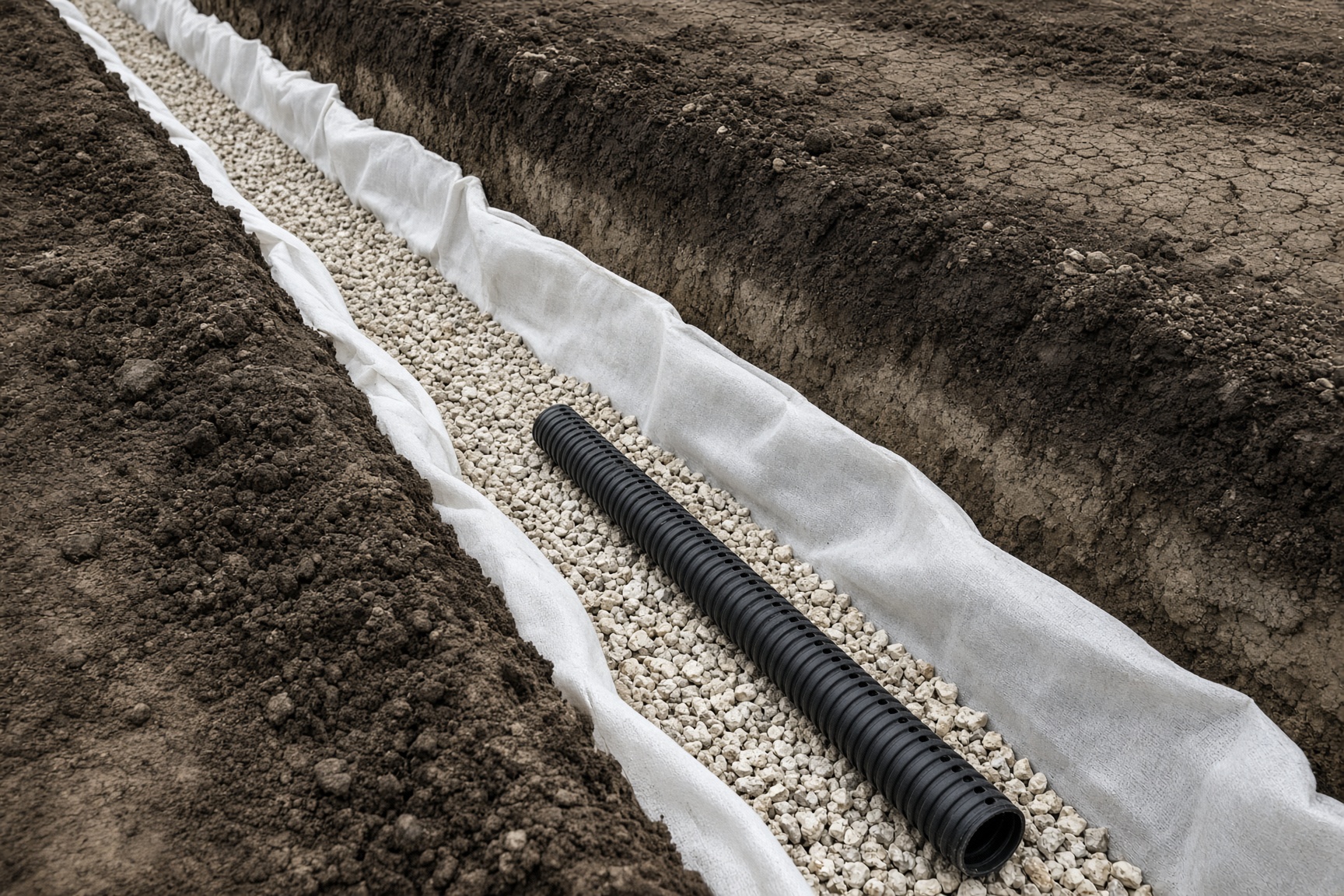
Start at the wrong end
The outfall sets the depth
A French drain moves water because it falls. Water has to enter the pipe at one end and leave at the other, lower end, on its own. So the first thing to find is not the trench. It is the point where the water is allowed to come out: a slope, a ditch, a swale, an approved tie in.
Once that outfall elevation is known, the pipe at the far end has to sit high enough to reach it with fall to spare. Work backward from there and the depth at the collection end falls out of the arithmetic. Pick a depth first and you can dig a beautiful trench that holds water like a bathtub.
The rules that do apply
Fall, cover, and the wet zone
- Fall. The pipe needs continuous slope toward the outfall along the whole run. A common target is about an inch of drop for every eight to ten feet, and it has to be consistent. One flat spot or one belly and the line silts up there.
- Cover. Enough soil and rock above the pipe that mowers, foot traffic, and a truck tire do not crush or expose it. On a lawn run that usually means the top of the rock stays several inches below grade.
- Below the wet zone. The pipe has to sit under the layer that is holding water, not in it. On blackland clay the perched water often sits in the first foot or so above the clay, which is what a drain at that depth is there to intercept.
- Above the utilities. Gas, electric, irrigation, and fiber all live in that same first few feet. Locates get called before anything is cut. This is not optional and it is not a formality.
Cases
Where the number actually lands
- Surface ponding
A fence line pond on clay with a slope nearby is often intercepted with a shallower run, because the water is sitting near the top and the outfall is close.
- Perimeter of the slab
A line meant to keep roof and lot water off a foundation edge generally goes deeper, since it is chasing water that has already gotten into the soil column.
- Long run to a far outfall
If the only legal discharge is a hundred feet away and barely lower, the collection end has to start deep to hold fall the whole distance.
- Limestone shelf
Rock can cap the depth. When it does, the answer is sometimes a different line or a different discharge rather than fighting the shelf.
What a shallow drain fails at
A trench that is too shallow intercepts the puddle you can see and nothing under it. The yard looks better for a season, the water finds the path around the pipe, and the complaint comes back the next wet spring. That is the most common reason we get called to a yard that already has a drain in it.
Start here
Tell us what the yard is doing
The form is how jobs start. You describe what you see after a storm, we walk the lot, then you get scope and price on paper. Nothing is priced over the phone.
Get a drainage quote
Tell us the city and what the yard does after a rain. We answer about an inspection and a written quote.