Roof water
Downspout drainage that carries water away
A two story roof over a four foot side yard puts an enormous amount of water into a very small strip of dirt. Splash blocks move that problem about eighteen inches. Underground extension moves it off the lot.
Why it matters here
The gutter is often the whole problem
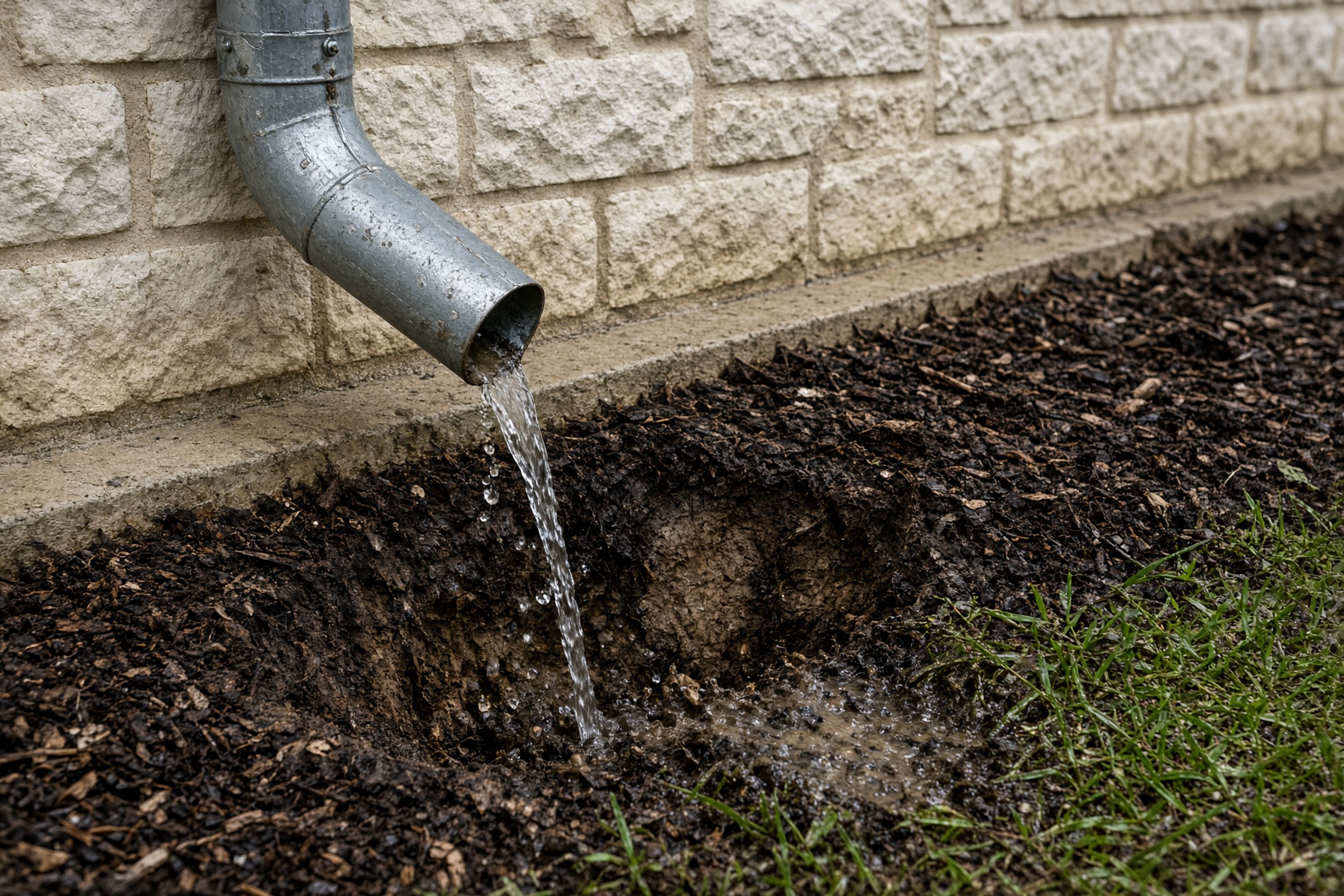
On new Williamson County builds, the downspout is set close to the slab and finished sod goes in around it. Every storm, the roof concentrates into a few outlets and dumps it in the one place you least want water: against the foundation edge, in a strip too narrow to drain.
Before we ever mark a trench, we check whether the yard is genuinely holding water or whether the gutters are simply putting it there. Those need different fixes and different money.
If the gutter is the source, the drain starts at the spout. That is cheaper and more effective than a long trench chasing water somewhere downhill.
The fix
Buried extension to a real discharge
- Solid pipe from the spout, not perforated. Roof water should be carried, not released into the trench it is passing through.
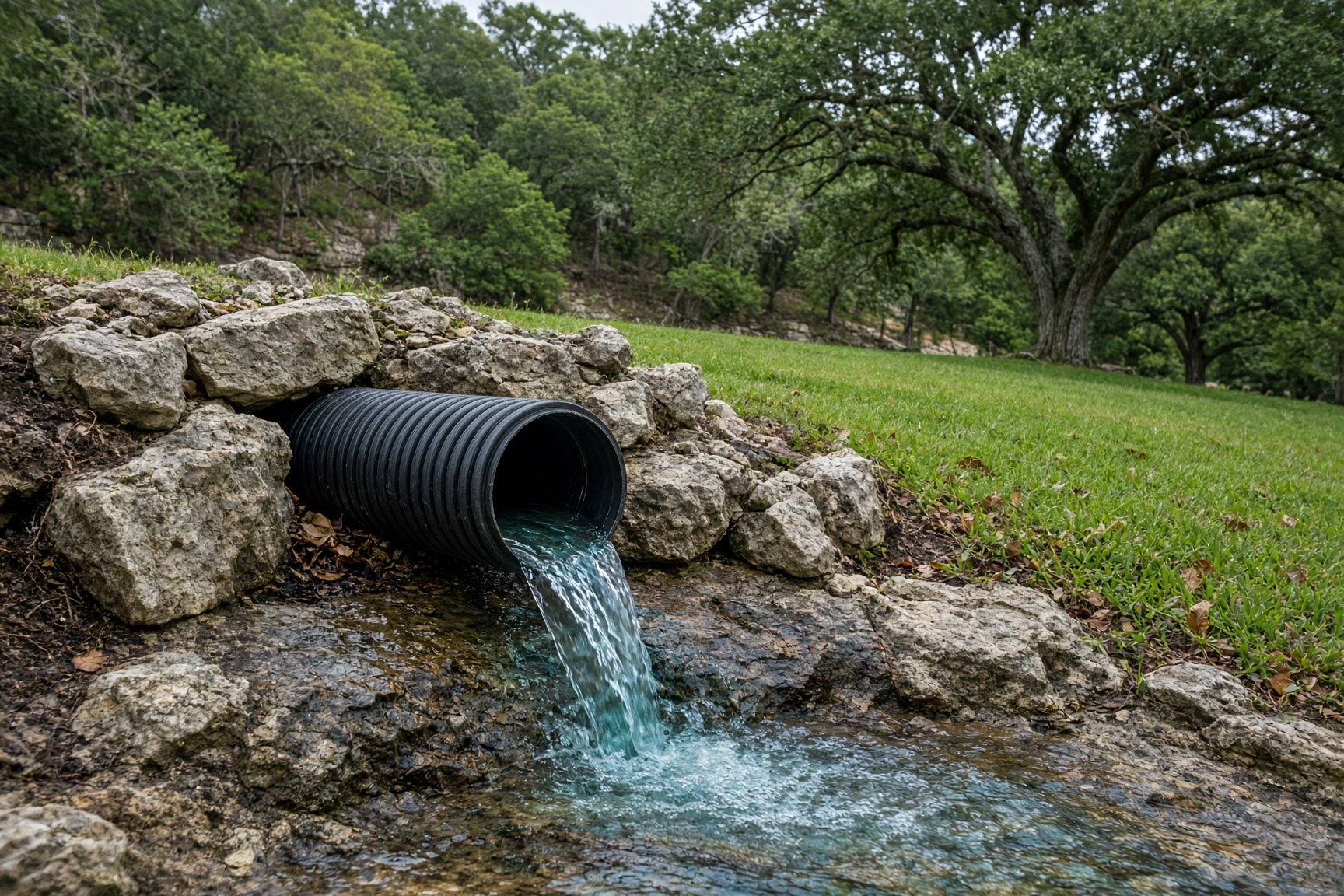
- Graded to the same legal outfall the drain uses, or to a pop up emitter that opens under pressure and closes after.
- Cleanouts or accessible joints, so the line can be cleared if a nest or shingle grit blocks it.
- Buried deep enough to mow over and cross with a vehicle without crushing.
A distinction worth understanding
Solid pipe and perforated pipe do opposite jobs
A French drain uses perforated pipe wrapped in fabric and bedded in washed rock. Its job is to let groundwater in along the whole run and carry it out the end. Holes down, rock around, water enters everywhere.
A downspout line uses solid pipe with no holes. Its job is the opposite: keep the roof water sealed inside and put it out at one chosen point. Run roof water through perforated pipe and you have built a device for injecting hundreds of gallons directly into the soil beside your house.
Combining them takes some care. The two lines can share a trench and share an outfall, but the roof water stays inside solid pipe the entire way there.
Sanity check
Things to look at before you call anyone
- During the rain
Go out mid storm with an umbrella. Where the water is actually going during the event tells you more than the puddle left behind.
- At the spout base
A washed out crater, exposed slab edge, or a stripe of silt fanning across the lawn means the roof load is the source.
- Gutters themselves
Overflowing at the seams means they are blocked or undersized. That is a gutter job first and a drainage job second, if at all.
- Existing buried line
If a previous owner put in extensions, check whether the ends have silted shut. A blocked line backs up at the spout and looks exactly like no line at all.
Start here
Tell us what the yard is doing
The form is how jobs start. You describe what you see after a storm, we walk the lot, then you get scope and price on paper. Nothing is priced over the phone.
Get a drainage quote
Tell us the city and what the yard does after a rain. We answer about an inspection and a written quote.